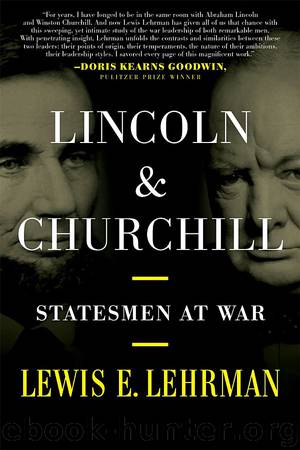
LINCOLN & CHURCHILL by LEWIS E. LEHRMAN
Author:LEWIS E. LEHRMAN
Language: eng
Format: epub
ISBN: 9780811767453
Publisher: STACKPOLE BOOKS
Published: 2018-01-12T05:00:00+00:00
Churchill did not cease his diplomacy on behalf of Poland. (Similarly, Lincoln never stopped trying to help Union loyalists in eastern Tennessee break away from the Confederacy.) After trying to broker an agreement between the London Poles and Stalin’s Lublin Poles, the prime minister argued in a letter to Stalin in early March 1945: “Force can achieve much but force supported by the goodwill of the world can achieve more. I earnestly hope that you will not close the door finally to a working arrangement with the Poles which will help the common cause during the war and give you all you require at the peace.”27 Churchill persisted, writing the Russian dictator late in April 1945, after FDR’s death, that the British people “can never feel this war will have ended rightly unless Poland has a fair deal in the full sense of sovereignty, independence, and freedom, on the basis of friendship with Russia.” Churchill warned Stalin: “There is not much comfort in looking into a future where you and the countries you dominate, plus the Communist parties in many other States, are all drawn up on one side, and those who rally to the English-speaking nations and their associates or Dominions are on the other. It is quite obvious that their quarrel would tear the world to pieces and that all of us leading men on either side who had anything to do with that would be shamed before history.”28
The Soviet dictator could not be shamed by Churchill’s appeal to peace and honor. For the prime minister, support of a free Poland had been a matter of principle—the very principle that had brought Britain into the war in September 1939—after Hitler’s invasion of Poland. For Stalin, the Poles were pawns in a deadly game of Bolshevik real politik. Stalin’s geopolitical strategy aimed to close off the historic invasion path to Russia through Poland and the Ukraine. As Averell Harriman, the U.S. ambassador to Moscow, acknowledged to Churchill: “The Russian bear is demanding much and yet biting the hands that are feeding him.”29 Indeed, Russia was a great beneficiary of U.S. Lend-Lease support. Moreover, the prime minister himself did have a long history of opposing the Russian Revolution. Stalin had not forgotten Churchill’s support for British intervention against the Bolsheviks in 1918–1920.30 By the Potsdam Conference of July 1945, the prime minister had lost patience with the Polish issue: “I’m sick of the bloody Poles. I don’t want to see them. Why can’t Anthony [Eden] talk to them? If I have to see them I shall tell them there is no support in western Europe for a puppet Polish state, the tool of Russia.”31
Churchill’s war against Bolshevism after World War I had begun in 1919, with a very limited British army intervention in Russia to stem the tide of communist revolution. No statesman of the twentieth century perceived so early the threat to the free world of Soviet totalitarianism. No statesman was more committed, when armed intervention failed in 1920, to the peaceful extinction of communism.
Download
This site does not store any files on its server. We only index and link to content provided by other sites. Please contact the content providers to delete copyright contents if any and email us, we'll remove relevant links or contents immediately.
Waking Up in Heaven: A True Story of Brokenness, Heaven, and Life Again by McVea Crystal & Tresniowski Alex(37925)
Empire of the Sikhs by Patwant Singh(23205)
We're Going to Need More Wine by Gabrielle Union(19169)
Hans Sturm: A Soldier's Odyssey on the Eastern Front by Gordon Williamson(18724)
Leonardo da Vinci by Walter Isaacson(13512)
The Radium Girls by Kate Moore(12182)
Tools of Titans by Timothy Ferriss(8594)
Educated by Tara Westover(8173)
How to Be a Bawse: A Guide to Conquering Life by Lilly Singh(7614)
Permanent Record by Edward Snowden(5961)
The Last Black Unicorn by Tiffany Haddish(5722)
The Rise and Fall of Senator Joe McCarthy by James Cross Giblin(5369)
Promise Me, Dad by Joe Biden(5229)
The Wind in My Hair by Masih Alinejad(5194)
A Higher Loyalty: Truth, Lies, and Leadership by James Comey(5089)
The Crown by Robert Lacey(4935)
The Iron Duke by The Iron Duke(4466)
Joan of Arc by Mary Gordon(4211)
Stalin by Stephen Kotkin(4069)
